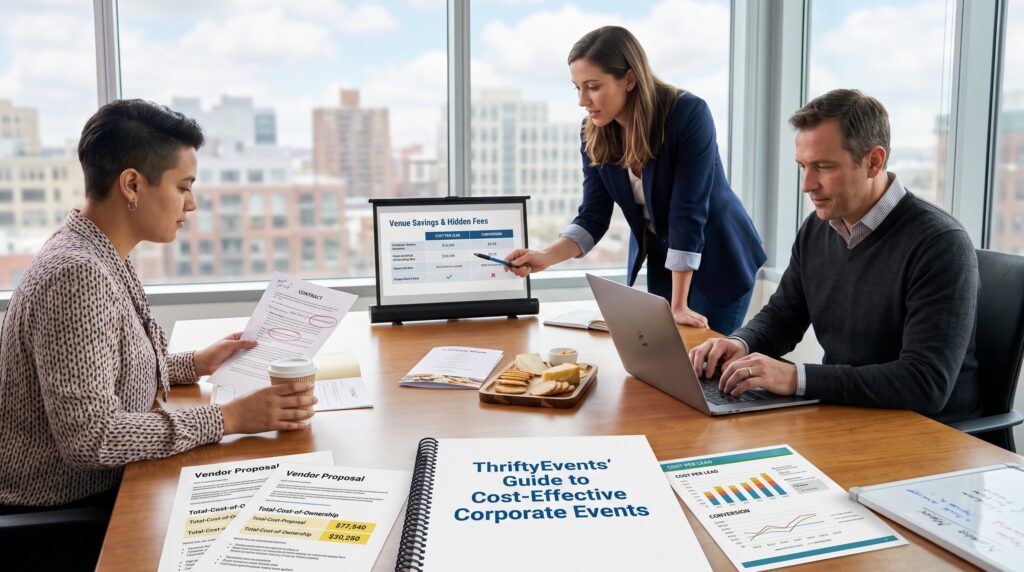
ThriftyEvents’ Guide to Cost-Effective Corporate Events starts with one clear rule: set goals before buying anything. Organizers who reverse-engineer budgets from measurable outcomes, leads, training hours, or engagement scores, save money and get better results. This guide lays out a step-by-step approach to align spend with objective, estimate realistic per-attendee costs, and cut waste in venue, catering, AV, and staffing. It uses concrete numbers, lessons learned from real planners, and practical links to ThriftyEvents resources so teams can plan smart and save big in 2026.
Table of Contents
ToggleKey Takeaways
- ThriftyEvents’ Guide to Cost-Effective Corporate Events emphasizes setting clear goals before budgeting to reduce wasted spend by 20-30%.
- Allocate 60-70% of the budget to core elements like venue, catering, and AV, prioritizing items with the highest impact on attendee outcomes.
- Use realistic per-attendee cost estimates and build optimistic, expected, and conservative budget scenarios to enable precise adjustments as attendance fluctuates.
- Maintain disciplined tracking with a live budget spreadsheet and reserve 10-15% contingency to manage overruns and ensure financial control.
- Leverage negotiation and in-kind sponsorships by preparing concise event value briefs to convert costs into partnerships, saving significant expenses.
- Prioritize cost-saving strategies such as choosing off-peak venue dates, simplified catering, bundled AV services, and hybrid event formats to maximize value without sacrificing quality.
The ThriftyEvents Approach To Budget-Friendly Corporate Events
Fact first: events planned with clear business goals reduce wasted spend by roughly 20–30% versus feature-first planning. The ThriftyEvents approach begins by naming the primary objective, for example, generate 120 qualified leads or deliver 16 training hours per attendee. With that target, planners set outcome metrics and then allocate dollars to the few elements that move the needle: venue access, sound quality, and content delivery.
Why this matters: a single broken microphone can cost credibility and the equivalent of multiple meal budgets. ThriftyEvents recommends treating venue, catering, and AV as core experience drivers and treating décor and swag as secondary. Planners who use this mindset report cleaner decisions when bids exceed budget.
Practical link: ThriftyEvents keeps curated vendor lists and pricing templates that help planners compare fixed and variable costs quickly. Use the site’s ultimate guide to budget-friendly event planning for real-world vendor rates and negotiation talking points.
Real lesson: one organizer saved $4,200 by switching to a hybrid format and reallocating savings to a higher-quality speaker. They tracked engagement with simple post-session quizzes and proved the reallocation increased actionable leads by 18%.
Build A Practical Budget That Aligns With Event Goals
Answer: reverse-engineer the budget from measurable goals and use allocation bands. Start by defining the target metric (e.g., 200 registrants, 50 qualified leads). Then apply an allocation model: 60–70% for venue/F&B/AV, 20–30% for programming and marketing, and 5–10% for contingency. This distribution keeps the core experience funded while preserving flexibility.
ThriftyEvents offers a step-by-step planner that maps goals to costs and suggests scenario-based budgets for different attendance levels. The 2026 planning guide includes templates to scale estimates when expected attendance changes.
Vulnerability moment: planners often underprice registration friction. One team set registration fees too low and had to cut speaker honoraria the week before the event. The fix was a simple stress test: reduce expected attendance by 25% and confirm whether essentials still have funding. If not, adjust programming, not quality.
Estimate Costs And Prioritize Line Items
Direct answer: estimate per-attendee costs from historical data and current vendor quotes, then prioritize items that drive attendee outcomes. Use a table with three columns: estimated cost, committed cost, and impact score (1–5). Focus spend on items with impact scores of 4–5.
Example: if a venue quote is $12,000 for 300 people, per-attendee venue cost equals $40. AV estimate of $3,600 adds $12 per person. If the content drives conversions, allocate more to AV and speaker fees rather than premium décor. Use the ThriftyEvents savings case study: switching from plated multi-course meals to a high-quality boxed lunch saved 22% per head while preserving attendee satisfaction.
Link and resource: when estimating and benchmarking per-attendee costs, the ThriftyEvents article on platform savings provides concrete figures from past events and vendor comparisons. See the save 30% platform analysis for sample calculations.
Practical tip: build three scenarios, optimistic, expected, and conservative, and price each line by attendance elasticity. That makes last-minute cuts surgical instead of chaotic.
Track Spending, Set Contingency, And Measure Simple ROI
Clear fact: disciplined tracking prevents small overruns from becoming budget crises. Maintain a live budget spreadsheet that lists estimated vs. committed vs. actual for every line item. Reserve 10–15% contingency: ThriftyEvents normally recommends 10% for experienced teams and 15% for first-time events.
Concrete example: a technology summit budgeted $86,000 with a 10% contingency ($8,600). A last-minute AV upgrade cost $4,200, leaving $4,400 for other overruns. Because the team had committed amounts tracked, they reallocated a marketing holdback and avoided sponsor shortfalls.
Link: for guidance on saving on supplies and reassigning contingency, consult the ThriftyEvents planning and supplies overview at ThriftyEvents explained.
Measure ROI simply: compare qualified leads, NPS delta, or hours of training delivered against total spend. Express results as cost per qualified lead or cost per training hour. Planners who track these KPIs make better vendor choices year over year.
Top Cost-Saving Strategies For Venue, Catering, AV, And Staffing
Direct insight: venue, catering, AV, and staffing offer the biggest savings with the least impact on outcomes when managed strategically. Use off-peak dates, hybrid formats, and vendor consolidation to cut venue and catering costs by 15–50%.
Venue tactics: pick weekday afternoons or Sunday evenings for lower rental fees. Negotiate bundled rates that include basic AV and setup. The ThriftyEvents review of rental options highlights regional vendors with predictable pricing and bundled packages: it helps planners compare total landed cost, not just the rental fee. See the event rentals review for examples and vendor contacts.
Catering tactics: simplify menus to two main options, limit alcohol to a controlled cash bar, and consolidate meal functions to lower headcounts at peak times. One client reduced food spend by $7.50 per head and increased post-event satisfaction by offering three high-quality stations instead of plated service.
AV tactics: list required AV outcomes in the RFP rather than picturesque set pieces. Ask vendors to quote for essentials first, then add optional scenic items as line items. Bundling AV with the venue or a single AV provider often reduces markups.
Negotiate, Partner, And Leverage In-Kind Sponsorships
Key answer: negotiation and in-kind sponsorships convert costs into partnerships. Negotiate every major contract: typical concessions of 10–15% are realistic. Prepare a one-page event value brief that lists visibility, attendee profile, and expected impressions to trade for in-kind support.
In-kind examples: printing, transport, AV equipment, staffing, and media promotion. One planner traded booth space and lead data access for complimentary on-site AV, saving $3,200. Document deliverables in the contract and record sponsorship revenue in the budget as a negative cost line.
Resource: ThriftyEvents’ step-by-step partner outreach templates and sample deliverables help structure offers and track obligations. Use the Start ThriftyEvents guide for outreach language and reporting templates.
Cautionary note: never promise attendee data without legal clearance. Several teams learned this the hard way and had to redact reports. Always list data deliverables precisely and follow privacy rules.
Conclusion
Insight: cost-effective corporate events come from goal-driven budgets, tight tracking, and converting supplier costs into partnership value. By prioritizing experience drivers, using scenario budgets, and documenting sponsor deliverables, teams can cut costs while increasing measurable impact. ThriftyEvents resources and templates make these steps repeatable and auditable for future events.