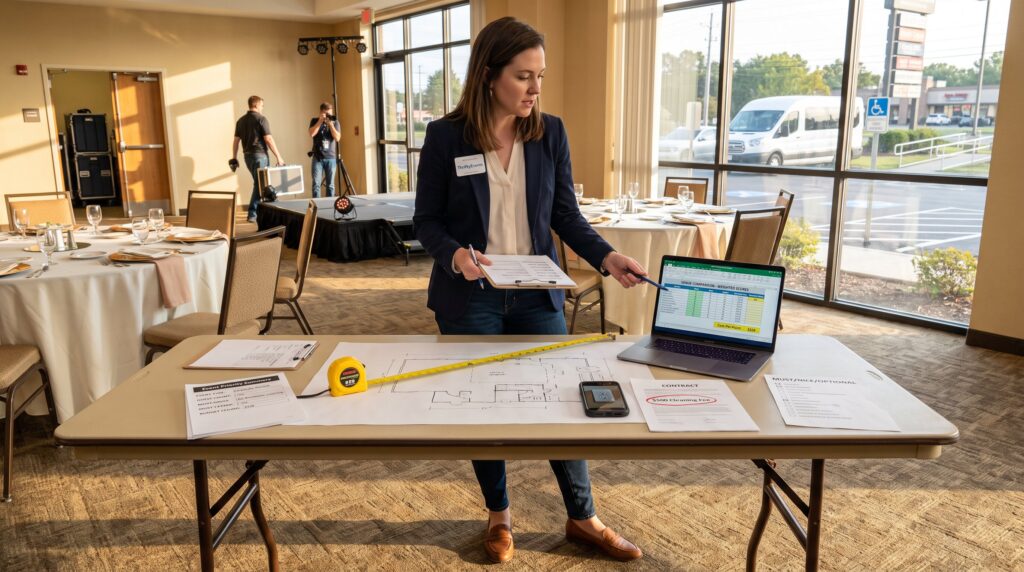
How ThriftyEvents Recommends Comparing Venues, Vendors, and Packages starts with one clear fact: side-by-side comparison saves planners money and hours. For budget-savvy organizers, a method beats instinct. This guide lays out ThriftyEvents’ step-by-step frameworks for comparing venues, evaluating vendors, and sizing packages so decisions are objective, quick, and trackable. It includes checklists, cost traps to avoid, and concrete examples a planner can use today. Read on to turn price confusion into a repeatable process that protects the budget and the guest experience.
Table of Contents
ToggleKey Takeaways
- ThriftyEvents emphasizes side-by-side comparison of venues, vendors, and packages to save planners up to 18% on event costs and reduce decision time.
- Start by defining clear event requirements like guest count and AV needs to avoid vague quotes and unexpected fees.
- Use ThriftyEvents’ weighted checklist framework to objectively score venues, prioritizing capacity, cost, amenities, and ambience based on event type.
- Build detailed cost matrices that include base rates, hidden fees, and flexibility policies to uncover true pricing and reduce risk.
- Compare vendor packages by total value considering scope, responsiveness, reputation, and transparent pricing rather than sticker price alone.
- Document every step with decision summaries and use ThriftyEvents’ platform tools to create auditable, evidence-based selections that protect the budget and guest experience.
Why Smart Comparison Matters For Budget-Savvy Event Planners
Smart comparison prevents costly assumptions. Planners who compare options side-by-side reduce overspend and last-minute compromises. ThriftyEvents data shows users who shortlist three venues and two vendor packages average 18% lower final costs than those who pick first-available.
Start with requirements, not with the fanciest listing. A clear requirement list keeps the search focused: guest count, AV needs, catering limits, and nonnegotiables like accessibility. ThriftyEvents recommends documenting those criteria before requesting quotes, because vendors often bid to the vague ask and add fees later.
A practical habit: create a documented decision summary for each finalist. That single sheet should list capacity, base rate, typical add-ons, and contact responsiveness. ThriftyEvents’ platform supports this by showing comparative pricing and availability across listings, helping planners move from impression to evidence-based choice.
Common mistakes to avoid: assuming capacity equals comfort (it doesn’t), ignoring operational needs (loading docks, kitchen access), and skipping written flexibility policies. Those errors add unexpected costs and friction during setup.
ThriftyEvents’ Venue Comparison Framework
The core insight: compare venues with the same lens every time. ThriftyEvents recommends a four-step framework: define requirements, shortlist three venues, apply a weighted checklist, and record commercial terms. This structure turns fuzzy preferences into scoreable facts.
Why weights matter. Not every factor is equal: capacity and core amenities usually carry heavier weight than decorative features. ThriftyEvents advises allocating 40% of the score to capacity and layout, 30% to cost and fees, 20% to amenities and service, and 10% to ambience and brand fit. Weights can shift by event type, a trade show prioritizes layout more than a cocktail reception.
Practical next step: upload shortlisted venues into a comparison table on the platform, then populate each field from vendor documents and site visits. That creates an auditable trail for stakeholders and reduces the impulse to accept the first emotional favorite.
Useful reference: planners who want a broader primer can consult the site’s overview on how the platform helps with supplies and rentals in 2026, which outlines the same comparative approach in longer form: thriftyeventsnet explained.
Venue Value Checklist: Capacity, Layout, Amenities, And Ambience
Fact first: capacity and layout determine whether the event will function, not just whether it fits. A listed capacity of 200 can feel like 120 when staging, buffet lines, and a photographer need space.
Capacity: verify both seated and cocktail configurations. Measure the space during a walkthrough or request a scaled floor plan. ThriftyEvents recommends noting the maximum usable square footage and comparing it to the guest list plus 20% for circulation.
Layout: map vendor access, load-in routes, and sightlines. That practical mapping prevents late changes that cost money. Example: one planner avoided a $750 extra labor charge by confirming truck access beforehand.
Amenities: inventory on-site items, tables, chairs, AV, linens, and green rooms. Note condition and backup options. If a venue lacks a kitchen and you need plated service, that’s a cost multiplier.
Ambience: capture photos at event hours (daylight and evening) and record noise levels. Ambience is subjective, but consistent notes help stakeholders agree. ThriftyEvents stores venue photos and notes so teams revisit the same evidence when deciding.
For a full planning checklist and budget template that pairs with venue comparisons, see the platform’s budgeting template resource: event planning template.
Cost Comparison: Nightly Rates, Hidden Fees, And Flexibility Policies
The headline: base rate is rarely the full story. Planners must compare nightly rates alongside predictable add-ons and flexibility terms. ThriftyEvents recommends building a cost matrix that separates recurring fees, one-time charges, and penalty clauses.
Nightly rates: capture the base rental fee and what it covers. Ask which hours are included and whether setup and teardown windows are charged. A venue can quote $4,000 per night but add $800 for extended load-out hours.
Hidden fees: list cleaning, security, overtime, insurance, and kitchen use fees. ThriftyEvents advises requesting sample invoices or a fee schedule in writing. That prevents surprise line items during reconciliation.
Flexibility policies: examine cancellation, force majeure, and rescheduling terms. Compare the monetary exposure in three scenarios: early cancellation, vendor no-show, and weather interruption. Venues with clear, fair flexibility policies reduce risk and save planners on contingency spend.
Tip: use the platform’s comparison export to share cost matrices with finance teams for faster approvals. For venue selection tied to company events and analytics, ThriftyEvents offers a focused guide that shows how selection affects promotion and ROI: planning a company event.
Comparing Vendors And Packages The ThriftyEvents Way
Clear answer: compare vendor offers by total delivered value, not by sticker price. ThriftyEvents surfaces side-by-side vendor offers so planners can compare pricing, reviews, and availability at a glance.
Start with scope. Vendor packages vary by what they include: number of staff, hours on site, setup, teardown, and substitution policies. A cheaper package that excludes setup may cost more after paying labor.
Assess responsiveness and reliability. ThriftyEvents tracks vendor response times and includes ratings: planners should weigh responsiveness heavily because slow replies cascade into schedule risk.
Budget-first approach: set a firm budget and ask vendors to propose packages that meet it. That’s supported by budgeting best practices, which recommend setting priorities and trimming the guest list or features when the budget tightens. For guidance on making budget decisions and spending with intention, planners can reference a detailed budgeting breakdown: wedding budget guide.
Practical test: request a scenario quote from each vendor, the exact same scope, then compare line items. When ThriftyEvents users do this, they identify hidden labor and substitution fees 60% of the time, often saving hundreds.
Vendor Evaluation Checklist: Reputation, Pricing Transparency, And Contract Terms
Topline: reputation and contract clarity predict fewer problems during execution. Use this checklist to vet vendors:
- Reputation: check verified ratings, recent client photos, and named references. ThriftyEvents lists vendor ratings and sample galleries to verify delivery.
- Pricing transparency: require itemized quotes that separate labor, materials, travel, and taxes. Transparent vendors reduce reconciliation time.
- Contract terms: scan for substitution policies, liability caps, and payment schedules. Watch for large nonrefundable deposits.
- Responsiveness: measure initial reply time and follow-up speed. Vendors who reply within 24 hours during negotiation usually stay responsive during delivery.
- Testimonials: read recent, detailed testimonials. Look for repeat clients and events similar in size and type.
Honest lesson: one planner selected a low-cost caterer because of price and later learned the contract required a specific dish minimum that doubled food spend. That mistake could have been avoided by checking pricing transparency and minimums ahead of contracting.
For side-by-side vendor comparisons and filters by ratings and location, ThriftyEvents provides searchable listings and package comparisons to speed selection: thriftyeventsnet reviewed.
Conclusion
ThriftyEvents’ approach is practical: define requirements, compare like-for-like, and document choices. Doing so reduces unexpected fees, shortens decision time, and protects the guest experience. Planners who follow the venue and vendor checklists will make clearer bids, negotiate smarter, and save both hours and dollars.